EU-India Mega Trade Deal: $53B Export Boom for India's MSMEs Amid Global Tariff Wars
EU-India FTA unlocks $53B export boom for MSMEs in textiles, leather & gems—zero duties on 95% lines. Discover agri-food gains, auto quotas & state-wise wins in this data-packed case study
 Editor
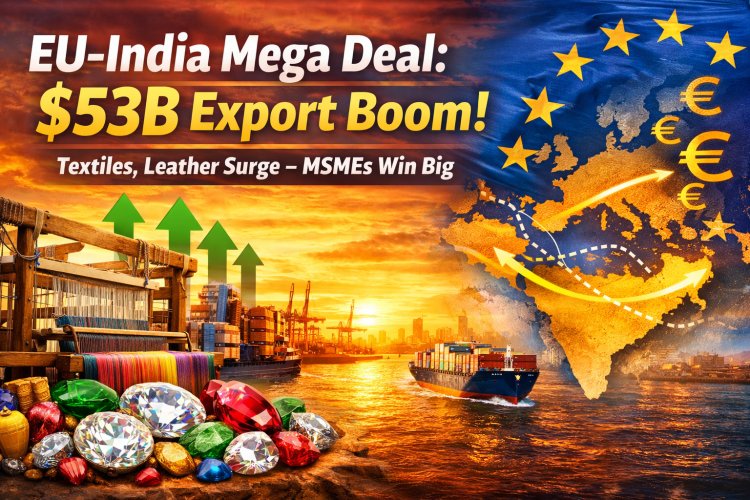
The EU-India Free Trade Agreement (FTA), finalized in late January 2026, eliminates duties on 95% of India's EU-bound exports, potentially unlocking $53 billion in new opportunities by 2030, with major gains for labor-intensive sectors like textiles, leather, and gems. This deal counters US tariff threats under President Trump by diversifying India's trade to Europe's vast market. It protects sensitive areas through quotas while boosting 12 key Indian states.
Talks, relaunched in 2022, accelerated amid US protectionism under President Trump, finalizing despite Bessent's criticism. India secured exclusions for autos and agri, with phased quotas; EU gains in services and premium goods. Implementation eyes 2027 start, with review clauses.
EU - India Deal Background
Negotiations accelerated in 2025 amid global shifts, including Trump's reelection and US protectionism, leading to the pact's signing on January 27, 2026. The agreement covers goods, services, and investments, creating a $2.7 trillion combined market. It builds on prior talks stalled since 2013, with India securing favorable terms on agri and autos.
EU- India Key Tariff Cuts
India eliminates or reduces duties on 9,425 tariff lines covering 95.3% of exports to the EU, up from 70% in 2022. Major beneficiaries include textiles (from 12% to 0%), electronics (14% to 0%), leather (17% to 0%), and engineering goods. EU cuts duties on Indian wines/spirits (150% to 20-40%), olive oil (45% to 0%), and processed foods (50% to 0%), while India allows limited EU agri imports like 50,000 tonnes of apples at 20% duty.
| Sector | Current Indian Export Duty to EU | Future Duty | Export Value Potential |
|---|---|---|---|
| Textiles & Apparel | 12% | 0% | $20B+ |
| Leather & Footwear | 17% | 0% | High MSME gains |
| Electronics | 14% | 0% | Corridors in TN, MH |
| Gems & Jewellery | Varies | 0% | Surat, Mumbai boost |
| Autos (Indian to EU) | High | 0% phased | Quota-based [user query] |
EU Agri-Food Gains
India cuts prohibitive tariffs, enabling EU wines (150% to 20-30%), olive oil (45% to 0%), processed foods (50% to 0%), and sheep meat (33% to 0%). Quotas for kiwis/pears (10%), juices (55% to 0%); wines/spirits group aids standards. EU protects beef, sugar, dairy; quotas for grapes, onions from India.
| EU Product | Current Indian Tariff | FTA Tariff | Market Potential |
|---|---|---|---|
| Wine | 150% | 20-30% | Premium sales surge |
| Olive Oil/Vegetable Oils | Up to 45% | 0% | Everyday consumption |
| Processed Foods (pasta, chocolate) | Up to 50% | 0% | Urban India demand |
| Sheep Meat | 33% | 0% | Niche markets |
| Beer | 110% | 50% | Craft segment |
Sector Impacts
Textiles, leather, handicrafts, sports goods, and marine products—covering 70% of affected lines—gain duty-free access, aiding MSMEs in clusters like Tiruppur (TN apparel) and Surat (Gujarat diamonds). Engineering, pharma, and electronics see 97-99% lines liberalized, benefiting hubs in Pune and Hyderabad. Agri exports like tea, spices rise, but sensitive items like dairy remain protected.
MSMEs in 12 states gain duty-free EU entry for $33B labor exports: textiles (Tirupur), leather (Kanpur), gems (Surat), marine (Gujarat). Engineering/plastics see 97% lines freed; autos quota-limited (110% to 10% over 5 years). Rs 6.4 lakh crore (~$77B) total boost projected.
Regional Winners
Twelve states gain: Maharashtra (pharma, electronics), Gujarat (textiles, marine), Tamil Nadu (leather, apparel), Uttar Pradesh (leather), and others like Kerala (spices) and Punjab (sports goods). Coastal areas boost shrimp/marine exports; inland clusters expand handicrafts. Total projected export lift: Rs 6.4 lakh crore (~$77B).
Auto Sector Nuances
India cuts EU car duties from 110% to 10% over 5 years, but with quotas (possibly 250,000 units) for EVs, heavy, and luxury vehicles (min ₹25 lakh on-road).[user query] EU phases Indian car duties to zero, offering 2.5x quota reciprocity; no benefits for cars under €15,000.[user query] EVs see delayed cuts till year 5, easing local industry pressures.
Challenges and Reactions
US Treasury nominee Bessent expressed disappointment, urging South Korea to ratify its deal first. Critics warn of EU agri-food influx impacting farmers, though quotas safeguard dairy/rice. Markets rallied, reviving stocks hit by US tariffs. Analysts see balanced gains but advise monitoring implementation.
India protects dairy, cheese, poultry, fruits/veg; EU enforces strict SPS standards on Indian imports. NTBs, RoO compliance challenge small firms; bilateral mechanism activates on surges. Overall, deal diversifies India from US tariffs, targeting 2030 export doubling.